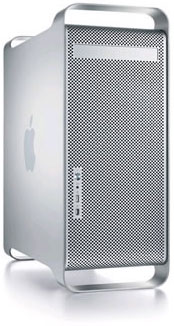
Apple PowerMac G5

November 10th, 2008 Paul Posted in Desktops, PowerMacs, PowerPC G5 No Comments »

The Powermac G5
The Power Macintosh G5 was introduced by Apple in 2004 as a replacement to it’s hugely successful G4 range of PowerMacs. Not only did the G5 PowerMac offer greater processing power than the G4 range, it also saw Apple move away from the curvy, plastic cases that had been used for it’s pro range of desktops since the original blue and white PowerMac G3 of 1999.
Instead Apple introduced an anodized aluminum alloy case with a distinctive front grill - a design that is now somewhat cruelly referred to as being like a cheese grater. Despite this the ‘cheese grater’ case is still in use in the 2008 range of MacPros.

Although it was only around for 2 years, the PowerMac G5 range saw a number of revisions made to it’s processor, ranging from a single processor 1.6 GHz model through to the final 2.5 GHz Quad Core model - the most powerful of all Apple’s PowerPC based Macs.

Read the rest of this entry »

AddThis Social Bookmark Button

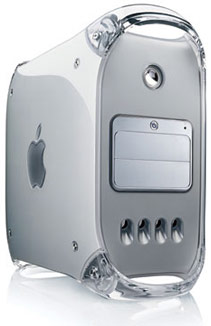
Apple PowerMac G4 MDD

November 9th, 2008 Paul Posted in Desktops, PowerMacs, PowerPC G4 No Comments »

The PowerMac G4 MDD
I must admit I have a bit of a soft spot for the G4 MDD (Mirrored Drive Doors), not only is it one of the best looking towers produced by Apple, the 1.25 Ghz version was also the last G4 model produced that was could still boot in Apple’s older Mac OS 9. This made it especially popular with users who still needed to run applications that couldn’t run in Mac OS X.

The MDD’s range included models with dual 867 MHz, 1.0 GHz and 1.25 GHz processors, the last of the MDD models had a single 1.25 GHz processor but could also be configured to come with dual 1.25 GHz processors.

Apple also produced three G4 PowerMacs sharing the same MDD casing, though these are referred to as FW models - the FW coming from the single Firewire 800 port that was introduced on these models. Unlike the true MMD PowerMacs, the Firewire's can’t boot in OS 9, they were available with 1.0 GHz, 1.25 GHz (x2) and 1.42 (x2) GHz processors.

Read the rest of this entry »

AddThis Social Bookmark Button